Rust, A 12-Minute Breakdown of Ownership and Types for Beginners
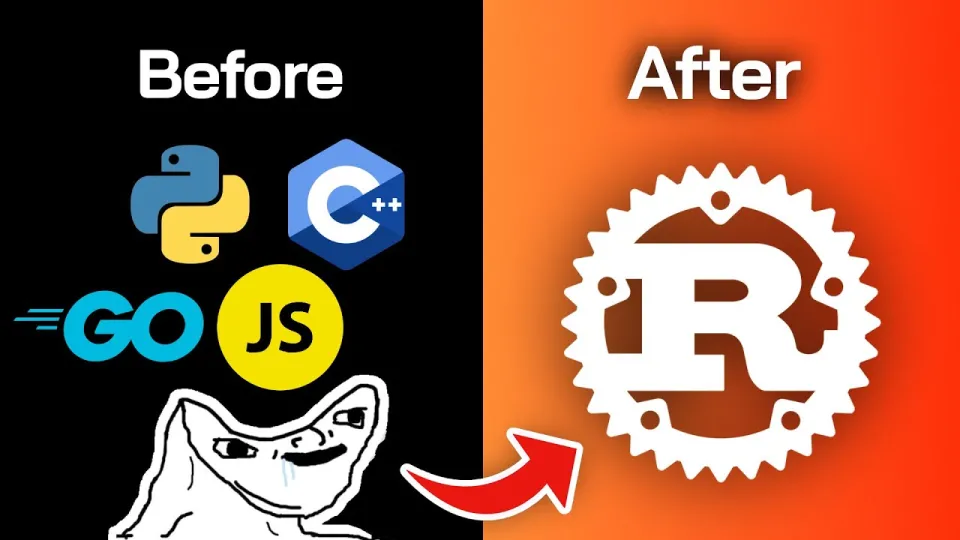
Video: Rust for Dummies in 12 Minutes
You can order the same kind of articles for your own video to boost it on YouTube and Google. Just message the Telegram bot @sat_sit_bot. Articles with your video embedded are written and posted by the bot itself — on popular topical sites (no ads). Free trial — 50 articles.
· based on the channel Let's Get Rusty
Rust is a compiled, statically typed programming language that guarantees memory safety without a garbage collector: the compiler enforces rules about who owns each value, so entire classes of bugs are rejected before the program ever runs. Instead of tracking down crashes in production, you fix them at build time, which is why Rust keeps appearing in operating systems, browsers, command-line tools and web services. If you want a structured path from first steps to job-ready skills, the Let's Get Rusty team offers a free Rust Job-Ready Roadmap and accelerator waitlist.
What Rust actually is and why beginners hear it is hard
Rust is a systems language in the same family as C and C++, but its design removes manual `malloc`/`free` bookkeeping from your code. Memory is managed through a set of compile-time rules rather than a runtime garbage collector. That combination — low-level control with high-level safety — is unusual, and it is the source of both Rust's reputation and its learning curve.
The difficulty is mostly front-loaded. You spend the first days fighting the compiler, then the rules become intuition. Three things trip up newcomers most often:
- Ownership: every value has exactly one owner at a time, and when that owner goes out of scope the value is dropped and its memory released.
- Borrowing: you can lend a value to a function by reference, but the compiler ensures no one mutates it while it is being read.
- Lifetimes: references must never outlive the data they point to, and the compiler asks you to prove it.
People coming from JavaScript or Python notice the contrast immediately: there is no `null` in the everyday sense, no silent coercion between a number and a string, and no runtime surprise where an object turns out to be undefined. The cost is that the compiler is strict; the benefit is that a whole category of crashes simply cannot compile.
Why Rust code doesn't break: ownership explained plainly
The core idea of ownership is simple to state: each piece of data has one owner, and when the owner disappears the data is cleaned up automatically. In languages where you call `free()` or `delete` by hand, forgetting the call leaks memory and calling it twice corrupts the program. In Rust, the drop happens for you at the end of the owner's scope, and the compiler refuses code that would use the data afterward.
A practical example of the pattern: a function that takes a `String` by value takes ownership of it, so the caller cannot use that variable again. If the function only needs to read the value, it should accept a reference instead, and the caller keeps ownership. The compiler error you get when you get this wrong is explicit — it tells you the value was moved and where — which is why so many learners describe ownership as suddenly obvious once they see the two versions side by side.
Borrowing adds one more rule: at any moment you may have either any number of immutable references or exactly one mutable reference, never both. That single rule eliminates data races at compile time, even before threads are involved. It also explains why Rust code often passes references (`&value`, `&mut value`) rather than moving values around.
The type system does the debugging for you
Rust's type system is where most of the day-to-day safety comes from. Types are checked at compile time, and the compiler will not silently convert one type into another. Comparing a number to a string, calling a method on something that might be missing, or returning the wrong type from a function are all build failures rather than production incidents.
The `Option<T>` type replaces null: a value is either `Some(value)` or `None`, and you must handle both cases before using the contents. The `Result<T, E>` type does the same for errors — a function that can fail returns a result, and ignoring it produces a warning. Pattern matching with `match` then forces you to write the branch for every case, which is how a lot of logic bugs get caught before testing even starts.
Rust also has no exceptions and no implicit truthiness. Combined with exhaustive matching on enums, this means adding a new variant to a type causes the compiler to point at every place that needs updating. For teams, that is a strong refactoring tool: change the data model and the compiler hands you a to-do list.
Rust compared with C++, JavaScript and Go
The most common comparison is with C and C++. Modern C++ does use smart pointers that free memory when they go out of scope, so the gap is narrower than the classic `malloc`/`free` picture suggests. What Rust adds is that the borrowing rules are enforced by the compiler for every reference, not adopted by convention, and that unsafe code must be explicitly marked.
Against JavaScript, the difference is philosophical. JavaScript checks types at runtime and lets `==` perform coercion; Rust checks at compile time and requires explicit conversion. A JavaScript developer moving to Rust usually finds the borrow checker the hardest part and the absence of runtime type surprises the most refreshing.
Against Go, the trade-off is readability versus expressiveness. Go optimizes for simple, uniform code that any team member can read; Rust optimizes for zero-cost abstractions and fine-grained control, which can produce denser code. Neither is wrong — they target different problems.
Common questions and doubts from learners
Several recurring concerns come up whenever beginners discuss Rust:
- "Is it really as hard as people say?" The syntax is not exotic; the ownership model is the real hurdle, and it usually clicks within a week of writing small programs.
- "Do I need to know C or C++ first?" No. Rust is self-contained, and prior experience with manual memory management can even make the rules feel unfamiliar at first.
- "What should I build?" Small command-line tools are ideal: read a file, parse lines, count words. They exercise ownership, error handling with `Result`, and the standard library without extra dependencies.
- "Is the ecosystem mature enough?" The package manager and build tool, Cargo, handles dependencies, testing and documentation, and installing a Rust-based tool typically means a single compile step that then just works.
- "Where do I go after the basics?" Read compiler errors carefully, work through the official book, and contribute to an open-source project you already use — many popular tools are written in Rust.
Where to learn more
The video breakdown referenced here is published by the Let's Get Rusty channel, which focuses on Rust education and career development. The main resource linked from it is the accelerator waitlist, which includes the free Rust Job-Ready Roadmap:
Summary
Rust trades a strict compiler for programs that do not break in the ways C, C++ and JavaScript programs typically do: no use-after-free, no double-free, no null dereference, no silent type coercion. Ownership, borrowing and the type system are the three ideas that make that possible, and they are learnable in an afternoon of reading plus a few evenings of practice. The 12-minute breakdown from Let's Get Rusty is a good first pass over exactly those two pillars — memory safety and types — before you move on to the official book and real code. Start with a small tool, read the compiler's messages instead of fighting them, and the language stops feeling hard surprisingly quickly.
Key takeaways
- Rust is a compiled, statically typed systems language with no garbage collector.
- Ownership rules mean each value has exactly one owner; memory is freed automatically when the owner goes out of scope.
- Borrowing lets code use a value by reference without transferring ownership, checked by the compiler.
- Rust's compiler catches use-after-free, double-free and many null and type mismatches at build time.
- The Let's Get Rusty video covers the topic in two parts: memory safety and the type system.
Questions & answers
Is Rust hard to learn for a beginner?
The syntax is approachable; the difficulty is the ownership and borrowing model, which the compiler enforces strictly. Most learners find it clicks after writing a handful of small programs, because every mistake comes with a precise compiler message explaining what went wrong and where.
Does Rust have a garbage collector?
No. Rust manages memory through compile-time ownership rules: each value has one owner, and memory is released automatically when that owner goes out of scope. This gives predictable performance without the pauses of a garbage collector and without manual free calls.
What is the difference between ownership and borrowing in Rust?
Ownership means a value has exactly one owner responsible for it; passing it by value moves that responsibility. Borrowing lets a function use the value through a reference without taking ownership, and the compiler guarantees the reference never outlives the data or conflicts with a mutable borrow.
Should I learn C++ before Rust?
No prior C or C++ knowledge is required. Rust is self-contained, and experience with manual memory management is not a prerequisite — some C++ developers actually find the enforced borrowing rules a bigger adjustment than complete beginners do.